
It is Air India's only profitable subsidiary. In 2016-17, it clocked a profit of over Rs 33.4 crore, earning Rs 620 crore in revenues from its handling operations.
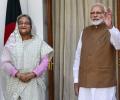
'If the Bangladesh-China relationship strengthens further, it can only be to India's detriment,' notes Vice Admiral Premvir Das.
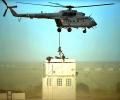
'It is time India thought big not only about its global clout politically and diplomatically, but also act its size against pin-pricking by anti national elements,' says Group Captain Murli Menon (retd).

Nikunj Saraf, Vice President Choice Wealth, answers your queries.

The Chinese military is now desperately attempting to give "ex post facto strategic meaning" to its actions in eastern Ladakh.

'Shastri told General Chaudhuri, 'I want to reach Lahore before they enter Kashmir'.' 'Today, many regard this initiative of Shastri as the first surgical strike.' A revealing excerpt from Dr Sandeep Shastri's Lal Bahadur Shastri: Politics And Beyond.
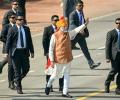
The 2019 election gives the Indian public the same choice: Between growth and oligarchs (or, in our case, dynasts and crony capitalists). If we chose wisely, well and good. If not, well, we have the Nehruvian Rate of Growth and massive corruption to fall back on. In a large sense, it is a choice between the India of the Lutyens elites and the Bharat of the real citizen, says Rajeev Srinivasan.

After missing two self-imposed deadlines, billionaire Mukesh Ambani's Reliance Industries Ltd on Friday announced recalibration of a proposed $15 billion deal to sell 20 per cent stake in its oil refinery and petrochemical business to Saudi Aramco, saying the two firms have agreed to re-evaluate the proposed investment in light of the Indian firm's new energy forays. The stake sale talks, which were first officially revealed in August 2019, are being reset in light of Reliance making forays into new energy business in recent months by investing $10 billion in alternative energy over three years. To pivot to green energy, it has already bought a German maker of photovoltaic solar wafers and signed a deal with a Danish company to manufacture hydrogen electrolysers in India.

'The era of conventional wars is almost over in the Indian context.' 'In such a scenario, special forces could play a decisive strategic role in the spectrum of conflict.'

The extent and nature of India's role in the ongoing turmoil in West Asia must be defined primarily by its strategic interests in the region. Few are, however, sure if New Delhi has any idea about its regional strategic interests, says Harsh V Pant.

He said the Fourth Industrial Revolution will have more importance than the capital.

'She was the unanimous choice of the search-cum-selection committee.'

Ahead of his talks with the Emirati leadership, Prime Minister Narendra Modi has said the Gulf region is vital for India's economic, energy and security interests.

'We should build a military with the capability to fight today's war on priority -- balancing it with the requirements of the future,' says Lieutenant General Anil Chait, one of the Indian Army's most cerebral thinkers who recently retired as chief of the Integrated Defence Staff, in his agenda for the new defence minister.

Nearly two decades ago, then defence minister George Fernandes said: 'China has built roads up to the border, while there has been negligence on India's part.' Since Fernandes uttered these brave words, what has been done on the Indian side? The Modi Sarkar is apparently trying, but little has been achieved so far, says Claude Arpi.
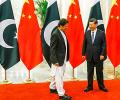
'If a 'two-front war' develops, Iron Brother may only turn out to be a drag on the PLA, since Pakistan is in no position to wage a war with India,' argues Ambassador M K Bhadrakumar.
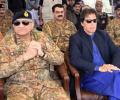
'Any conventional conflict could trigger a nuclear war with results that neither India nor Pakistan could survive easily.' >A revealing excerpt from Shuja Nawaz's The Battle For Pakistan: The Bitter US Friendship And A Tough Neighbourhood.

The Chinese air force is now a 400,000-person force that flies some 2,000 combat aircraft -- more than thrice the size of the Indian Air Force.

'One lesson to emerge out of the Modi-Putin summit is that India can be more self-confident that it possesses inherent strengths to leverage its interlocutors to influence Pakistani policies,' says Ambassador M K Bhadrakumar.
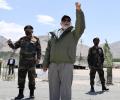
'It is a constantly evolving situation and will require deft handling at the ground level and at the highest level of military, diplomatic and political leadership,' observes Colonel S Dinny (retd), who served as Commanding Officer of an infantry battalion deployed in the Pangong Tso area.

This divisiveness is upsetting social cohesion and can throw the bright young people thronging to Bengaluru with billion dollar ideas in their creative minds off balance, warns Shekhar Gupta.

The Modi government has been put on notice.'Will it buckle under such pressure? These are times when the moral fibre of the leadership makes all the difference, observes Ambassador M K Bhadrakumar.
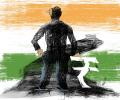
Expect a more modest out-turn of around 5 per cent (if not less) because of the longer-term scarring effects of the Covid shock, the sharply slowing growth in the pre-Covid years and some scepticism about the growth-efficacy of some of recent official policy initiatives, explains Shankar Acharya, former chief economic advisor to the government.

'China's growing nexus with Pakistan and the two countries' unresolved territorial disputes with India continue to pose a formidable national security threat to India,' says Brigadier Gurmeet Kanwal (retd).
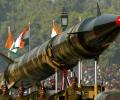
'We have worked to create road blocks in the path of those who thought that there was space for conventional war despite Pakistan's nuclear weapons.' 'Pakistan's nuclear weapons programme is not open-ended and aligned with India only.' 'In this unstable regional environment, one nuclear power is trying to teach lessons to another nuclear power through the medium of small arms and mortar shells on the Line of Control, and bluster.' 'A historic opportunity of a lifetime beckons the leaderships of India and Pakistan to grasp, sit together and explore the possibilities of conflict resolution.'

National carrier Air India is running in losses and needs government's attention.
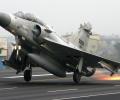
A realistic assessment will tell us that not much has changed between India and Pakistan; the relationship remains as fraught as before with little prospect of reconciliation, notes Ajai Shukla.

Union Minister Ravi Shankar Prasad on Tuesday urged state IT ministers to move swiftly and promote electronics manufacturing through pro-investment initiatives, in a bid to tap a "great opportunity" that now beckons India. Prasad, who interacted with state IT ministers through video-conference against the backdrop of the coronavirus pandemic, told reporters later that eased connectivity norms to facilitate work-from-home, which were to end on April 30, have now been extended till July 31.

'Institutional ownership, by December 2018, had increased 37.5% from approximately 22% in early 2009,' points out Amit Tandon.

'Islamabad receives billions in aid from the US but continues to harbour terrorists,' he said.

'The Panchsheel Agreement is unique in the annals of international relations as it stands out as a bizarre illustration of a prime minister trading his country's crucial national interests solely to buffer his personal international image,' feels R N Ravi.

'Until India fully absorbs the fundamentals of international relations, it will continue to get evil for good,' says Brahma Chellaney.

'Notwithstanding the realisation among the Indian leadership to build up its navy for the force's expanding role, the Indian Navy was allocated only 15% of the interim defence budget presented in Parliament in February 2019.' 'The outlay for the navy's capital acquisition is not even adequate to meet its committed liabilities,' points out Brigadier S K Chatterji (retd).

Fencing the border between Myanmar and Nagaland is expected to adversely affect the Naga tribals. Gautam Sen, an expert on Nagaland, explains why the Indian government needs a more comprehensive and long-term perspective on this issue and why it must take local tribal sensitivities and customs into account.
United States Secretary of State Hillary Clinton's visit to New Delhi last week was to prepare ground for the next US-India Strategic Dialogue to be held in Washington, says Alok Bansal

'Indian diplomacy faltered amidst multiple failures of statecraft.' 'The functionaries responsible must be held to account for their abject failure,' asserts Ambassador M K Bhadrakumar.
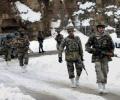
Within the army, there is growing concern that New Delhi will allow the Chinese to retain the territory they have occupied in the last month.
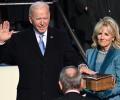
World leaders said they were looking forward to working with Joe Biden, as they welcomed the 46th President of the United States with praise and took parting shots at his predecessor Donald Trump.

'India-US defence pacts are seen by many analysts as a subtle move to jointly contain China's growing militarism, especially in the strategic Indian Ocean Region.'

'If we don't want to be the poorest large economy even in 2030, we need to be doing very much more than is being attempted.'
 © 2026 Rediff.com - Advertise with us - Disclaimer - Privacy Policy - Sitemap - Feedback - About us - Terms of use - Grievances